
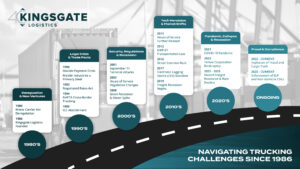
For nearly 40 years, logistics has been defined by volatility: regulatory overhauls, economic crashes, capacity shortages, pandemics, new technology mandates, bankruptcies, and more. Through every shift, Kingsgate Logistics has done what we do best: adapt quickly, communicate openly, and protect our customers and carrier partners.
Below is a journey through the major events that shaped our industry and how Kingsgate navigated each one.
The 1980s: Deregulation, Uncertainty, and a New Beginning
1980: Deregulation Reshapes the Trucking Landscape
The Motor Carrier Act dismantled federal rate controls and unleashed competition.
-
4,000 carriers failed by 1986
-
Driver pay declined
-
The number of carriers doubled
It was a turbulent market, but it created opportunities for companies built on trust and service.
1986: Kingsgate Is Founded
Tom and Merry Beckham launched Kingsgate Sales Associates during one of the most unstable periods in freight history. The company’s foundation of integrity and partnership became a stabilizing force for customers in a rapidly shifting market.
The 1990s: Legal Crises and Landmark Regulatory Rewrites
1990–1993: The Double-Payment Crisis
After a series of carrier bankruptcies, shippers across the country were hit with unexpected “undercharge” bills. Kingsgate supported customers through:
-
A Supreme Court ruling enforcing full filed tariff rates
-
Retroactive rate assessments
-
The 1993 Negotiated Rates Act, which finally stopped the retroactive billing
This period cemented Kingsgate’s commitment to transparency and advocacy for shippers.
1994: NAFTA and Cross-Border Growth
The North American Free Trade Agreement opened the door for increased U.S.–Mexico trade. Kingsgate adapted early to the complexities of cross-border operations and positioned itself for long-term growth in North American freight.
1995: The ICC Is Abolished
When the Interstate Commerce Commission was dissolved, the industry entered a new era of market-driven rate oversight. Kingsgate embraced the shift, focusing on fair pricing and dependable relationships.
The 2000s: Global Crisis and the Rise of Safety and Security
2001: 9/11 Reshapes Supply Chain Security
New compliance requirements, enhanced border screening, and updated security programs fundamentally changed freight movement. Kingsgate stepped in to help customers navigate new rules and build resilient strategies during a time of national uncertainty.
2003: Hours of Service Changes
With updated driving windows, rest periods, and duty limits, Kingsgate refined planning models and driver coordination to maintain service reliability under the new standards.
2008: The Great Recession Hits Trucking Hard
The industry faced widespread collapse.
-
785 carriers shut down in the third quarter alone
-
Diesel reached record highs
-
Tens of thousands of drivers left the workforce
Kingsgate’s stability and commitment to long-term partnerships helped shippers maintain continuity through one of the toughest periods in modern logistics.
The 2010s: Technology Mandates and a Tightening Labor Market
2011–2016: Hours of Service Revisions and Driver-Coercion Protections
New rules aimed at improving safety reshaped how carriers operated. Kingsgate aligned quickly with these standards, prioritizing safety and compliance throughout its network.
2012: MAP-21 Ushers in Modern Logistics Policy
With reforms that set the stage for ELDs, anti-coercion safeguards, and infrastructure improvements, Kingsgate invested early in technology and processes to stay ahead of the transition.
2017: The ELD Mandate
Electronic logging became the new norm. Kingsgate supported carriers through the transition and used the increased visibility to improve accuracy and strengthen performance expectations.
2019: The Freight Recession
Twelve straight months of declining demand put pressure on carriers and brokers nationwide. Kingsgate’s diverse customer base and service consistency helped offset the instability.
The 2020s: Record Freight Recession & Rate Decline
2021: COVID-19 and the E-Commerce Acceleration
Lockdowns caused immediate volatility, followed by a rapid surge in e-commerce demand. Kingsgate scaled operations, supported essential freight, and adapted quickly to new patterns of consumer-driven freight movement.
2023: The Yellow Bankruptcy
One of the largest LTL carriers in U.S. history ceased operations, causing significant disruption. Kingsgate acted quickly to help clients secure alternative capacity and maintain supply chain continuity.
2022-2025: The Prolonged Freight Recession
2025-Current: Heightened Enforcement of ELP and Non-Domiciled CDL Compliance
2022–2025: The Prolonged Freight Recession
Rates softened, capacity expanded, and bankruptcies increased across the industry. Kingsgate stayed focused on flexible pricing, diversified carrier relationships, and strategic support for shippers navigating unpredictable market conditions.
Ongoing Industry Challenges Kingsgate Continues to Lead Through
Fraud Prevention, Security, and Regulatory Compliance
E-Commerce and Market Transformation
The “Amazon effect” continues to reshape expectations for speed, visibility, and last-mile delivery. Kingsgate has expanded regional and last-mile capabilities to match the new freight landscape.